
Bringing the Future of Battlefield Technology Into Focus
THEON is one of the world’s leading developers of defense optronics. The group has more than 300,000 systems in service with Armed and Special Forces in 73 countries around the world, 26 of them NATO countries. THEON holds more than half of the night vision goggle market in Europe, and it won the largest single order ever placed for man-portable night vision equipment, for the German Armed Forces.
THEON’s newest story goes beyond any single device. Its A.R.M.E.D. ecosystem (Augmented Reality Modular Ecosystem of Devices) connects night vision, thermal, fused, and augmented reality systems into one network built for the Future Soldier. Every soldier on the team stays connected, shares the same picture of the mission, and sees what the rest of the team sees. That connection is the selling point, and it’s also the hardest thing to put on camera. A single binocular is easy to film. Data moving between operators across a team’s network, in the dark, is invisible.
THEON brought us in to produce Urban Blackout: When the Lights Cut, a film that follows a small team through a night operation and shows every device in the ecosystem doing its job. It’s one of the largest productions we’ve taken on, and it’s the kind of project leading defense manufacturers hand to a specialist. We came to it with years of work for defense and tactical brands, from EOTECH’s SHOT Show launch to Heckler & Koch’s VP9CC.
Defense Buyers Watch Differently
A defense product film plays to a different audience than a consumer ad. The people watching are militaries, procurement teams, and program evaluators, and many of them have used equipment like this in the field. They see the film at trade shows, in briefings, and during formal evaluations, and it has to hold up in every one of those rooms. With this audience, an operator who moves wrong or a device shown doing something it can’t will cost a film its credibility.
Defense work also comes with boundaries that commercial production doesn’t. THEON controlled what technical detail could appear on screen and what needed approval before release, and we built the production around that from the first conversation. Our team owned the creative depiction, THEON’s engineers owned the technology, and nothing went public without their sign-off. Defense manufacturers need a production partner that works comfortably inside those limits, and that’s a big part of why this work tends to go to specialists.
Every Device Gets a Role
Urban Blackout follows one mission from start to finish. In the morning, an operator receives the mission brief and intel through a THEA heads-up display. Then the lights cut across the city, and the mission begins.
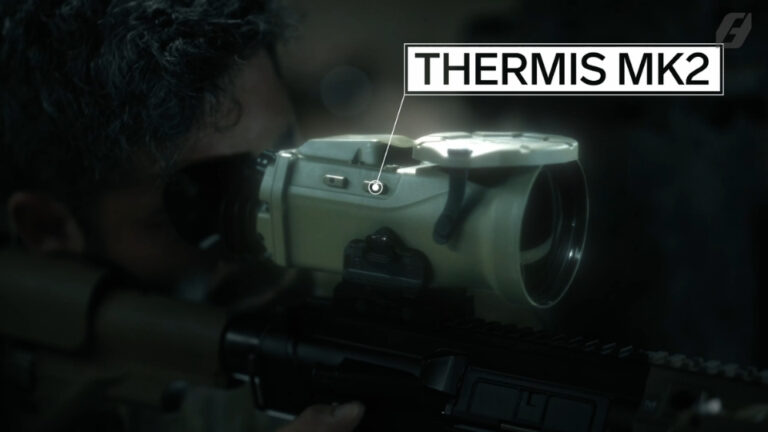
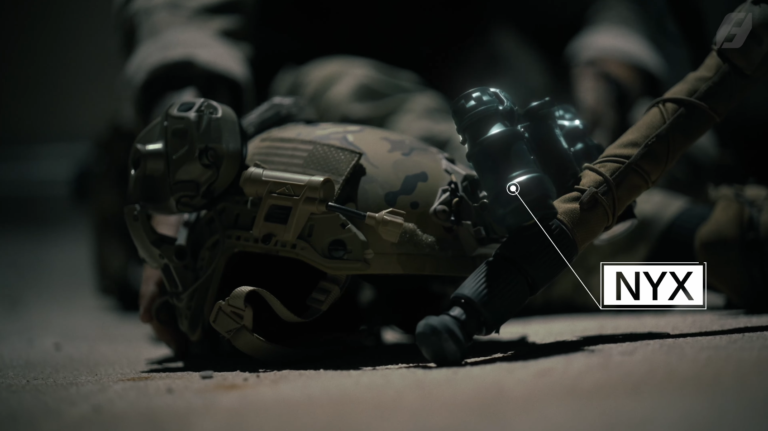
From there, every scene carries a product. The team wears NYX night vision binoculars. One operator views the compound through ORION fused binoculars, which combine thermal and intensified imagery in a single view. THERMIS thermal weapon sights cover short, long, and extra-long range across the team, and the DARK-I clip-on adds augmented reality and thermal integration to night vision goggles already in the field. We mapped every device to an operator and a moment in the script, so the film tours the full ecosystem without stopping the story to do it.
We also brought our own experience to the script. Before production, we worked closely with seasoned military operators and consultants to suggest revisions to the tactics and scenario, so the operators would move and communicate the way an experienced military audience expects. Getting that right takes a team that understands how military units operate as well as how to light a scene.
Days With THEON’s Engineers Before Day One on Set
A defense product film is only as accurate as the production team’s understanding of the hardware. Before production, we scheduled days of equipment testing with THEON’s technical staff to confirm how each device could be shown, what it displayed, and how its imagery looked through a lens.
That testing answered the hard questions early. It showed us which scenes we could capture in camera, which device views we could record directly, and where the script called for something no camera could capture on its own. Data moving between devices, a thermal snapshot relayed to a team, and an augmented reality overlay synced across a network are real functions, but they’re challenging to capture on set. We planned how to depict each of those processes from the start, so the most important features and functions would show accurately on screen and nothing surprised us in the edit.
A THEON technician stayed on set through production to advise on the equipment. On a defense shoot, that partnership is the difference between a film that looks impressive and one that looks impressive and right.
Shot in the Dark, Where the Products Live
To show these systems at their best on screen, we filmed primarily overnight at an industrial location. The shoot covered an overwatch position, an entry team clearing an industrial compound, a machine gunner marking a target with an infrared laser that only shows up through night vision, and a thermal drone view over the whole operation.
The film cuts between the camera’s view and the operators’ views. One shot is the cinematic angle on the team, and the next is the world through a NYX binocular, an ORION fused view, or a THERMIS sight shifting palettes. Those device views carry the film. They put the viewer behind the optics, which is exactly where the soldiers and evaluators choosing these systems will be.
CGI for the City, Real Hardware on Screen
No production can black out a city skyline on cue, so the film’s blackout plays out on a CGI city built for the shot. As the power grid fails, the lights go out block by block, and that darkness sets up everything that follows. We developed the shot in stages, starting with a low-resolution pass for review and refining it into the high-resolution version that cuts into the live-action footage.
We filmed THEON’s actual hardware on set. CGI and visual effects handled what a camera can’t capture: the city, the heads-up display symbology, map overlays, team tracking markers, and the data passing between devices. Advanced compositing tied those elements to the live footage, and the extraction ends with a helicopter arriving in thermal view, created in post.
Every effect had to match how the real hardware looks, so we built them from THEON’s reference footage and the device views captured on set. For a defense audience, an overlay that looks better than the real product is as much of a problem as one that looks worse. Advanced sound design tied it all together, with the effects and voiceover pacing the shift from the city to the compound to extraction.
Built for Every Room THEON Walks Into
With systems in service in 73 countries, THEON needed more than one edit. We delivered the full film in 4K along with separate versions for different markets, subtitled edits, and shorter cutdowns focused on individual products. THEON’s team reviewed every round in Frame.io, and their technical experts confirmed the details before each edit moved forward.
That range of versions lets one production work across the whole defense sales cycle. The same footage can carry a trade show booth, open a procurement briefing, and anchor THEON’s own channels, so building it to a military audience’s standard pays off well past the first release.
Why It Worked
We already knew the defense audience. Years of work for defense and tactical brands shaped the script, and revisions developed with seasoned military operators made the film credible to the soldiers and evaluators it was made for.
Compliance was part of the plan. Disclosure approvals and technical boundaries shaped the production from the start, so the film went public without surprises.
Testing came before shooting. Days with THEON’s engineers settled what the camera could capture and what visual effects needed to build, before anyone was on set.
The Future Soldier drove the story. Every device had an operator and a moment, so the film shows a connected ecosystem without reading like a spec sheet.
CGI filled the gaps, not the products. The city and the data layer came from CGI and visual effects, while THEON’s hardware stayed real on screen. The overlays match the hardware, so the film shows what the ecosystem does without overstating it.
Services Involved
- Video Production: Script development, storyboarding, pre-production, equipment testing, overnight on-location production, editing, visual effects, advanced compositing, advanced sound design, and multiple market versions and cutdowns.
- CGI Services: A CGI establishing shot of the city losing power, developed from a review pass to a high-resolution shot built to cut into live-action footage.
Ready to Talk?
Defense products tend to be the hardest to market and the hardest to film, and that’s where we do our best work. If you build for militaries, law enforcement, or security forces, fill out the form below and tell us what you need to put in front of your buyers.