The Site Is Always Up. That’s the Product.
What you’re buying with website management is the absence of a problem. The site is live. The plugins are current. The security patches went in before you heard about the vulnerability. The product page you asked about on Tuesday was updated Tuesday. And if something does come up, it’s an email, a call, or a text – not a ticket in a queue.
Plenty of agencies will keep a WordPress site patched. Far fewer can look at a Pistol Stabilizing Brace® spec sheet and know which numbers a buyer is actually comparing, or understand why a dealer-locator page matters more than a cart, or recognize that a new product in this category arrives with compliance considerations a generalist would never think to ask about.
That combination is the argument. Technical capability is table stakes. Technical capability plus knowing the industry is what makes a website manager useful rather than just available.
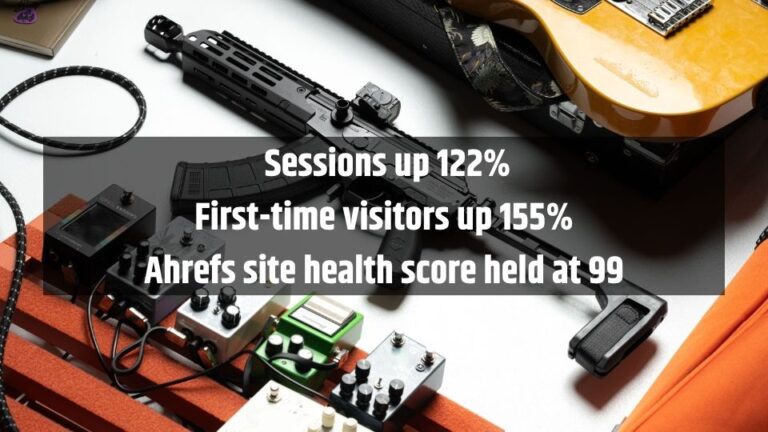
SB Tactical® launched the SBA6™ on July 27. Traffic grew 122% year over year in the month that followed, first-time visitors grew 155%, and the site’s health score never moved.

The Brand
SB Tactical builds Pistol Stabilizing Braces – the SBA3®, SBA4®, SBA5®, the HBPDW™, the 1913 series, and now the SBA6. The company sells exclusively through dealers and distributors rather than direct, which changes what a website is for. There’s no cart and no checkout. The site’s job is product education and getting a buyer to the Find a Retailer page.
That makes the website genuinely load-bearing rather than a brochure. Every product decision a customer makes happens on these pages. A team that doesn’t understand the category will treat those pages as layout problems. They’re product problems.
June: Building the Product Page Template
The headline from June wasn’t a page rebuild. It was a template.
Every product page on the site is being rebuilt to a single standard, and the SBA3 was where we started – not because that page needed the most help, but because it was the right model to build the standard from. What got built in June now carries the SBA6, the 1913 series, and every A-Series page as they roll through:
- A unified product page layout, with product imagery sized square for mobile alignment and search
- Spec tables driven by WooCommerce attributes rather than a hand-maintained tab, so specifications populate from product data and stay accurate as products change
- A related resources module surfacing downloadable assets directly on the product page
- A site-wide trademark standard for consistent symbol placement
- Retirement of an unused security service, cleared out of its portal
Alongside the template work, the month’s ongoing requests: a new online retailer added to the dealer locator, an updated SBA6 spec sheet staged, content refreshed across the A-Series pages, and the online retailer grid reordered.
Knowing which of those mattered most is where category knowledge earns its keep. Moving specs onto WooCommerce attributes sounds like a technical housekeeping choice. In a category where buyers compare overall length, weight, and material across four models before deciding, an accurate and consistently structured spec table is the page’s most important element. A generalist builds a nice-looking product page. Someone who knows the category builds the spec table first.

July: The Launch
The SBA6 page was built on July 23 and went live on July 27.
Four days, because the template already existed and the spec architecture populated itself from product data. On launch day the page published, the homepage swapped to approved launch creative, and the mobile experience was confirmed – all inside the same day the ad campaigns turned on.
The rest of the month’s deliverables: sign-off secured on the A-Series pages, which unblocked the email welcome series; a WP Engine vulnerability notice actioned across two plugins on July 16, eleven days ahead of the launch; a Search Console flag on pages indexed while blocked by robots, resolved the same week; and the 1913 product page series started, with missing FS1913A imagery flagged and a photoshoot slotted into the retainer.
That last item is worth pausing on. The page couldn’t be finished without product photography that didn’t exist yet, so it went onto the shoot list for the monthly retainer shoot. A website management vendor would have sent an email asking the client to provide images. We added it to our own production schedule, because the photography and the website are the same engagement.
What Happened
Sessions grew 72% in July and another 19% in August. Against the same month the previous year, sessions were up 122% and first-time visitors up 155%.
The traffic came from the launch campaigns and organic social. What website management delivered was a destination that was ready, accurate, and stable when all of it arrived.
On that count: the Ahrefs site health score held at 99 through June, July, and August, with 4 errors against 112 crawled URLs. Through a product launch, a template migration, a large traffic increase, and a run of plugin vulnerability notices, it didn’t move.
Traffic also shifted where we wanted it. Homepage views fell sharply while the SBA6 page became the primary entry point – visitors landing directly on the product rather than routing through the front door, which is exactly what the campaigns were built to do and exactly what the page had been built to handle.
When Something Does Come Up
Two vulnerability notices landed in August. One was patched on the live site. The other flagged an install that turned out to be a retained legacy staging backup rather than production – checked, confirmed, and closed out without unnecessary changes to the live site.
That’s the rhythm. Notices get triaged the day they arrive. Content requests get handled the week they come in. And the channel is direct: email, phone, or text to the people actually doing the work.
It’s fast because the same team is in the site every month. They know what’s installed, what’s custom, what the staging environment is for, and what changed last week. A site handed to someone unfamiliar with it during an emergency is a much slower and more expensive problem than the same site handed to someone who was in it yesterday.
The Part Most Agencies Can’t Offer
Website management sits inside the same engagement as the advertising, the email program, the social content, and the photography. All of it gets discussed on the same weekly call and reported together monthly.
That structure changes the work. The SBA6 page went live the same day the Meta and programmatic campaigns turned on because the people running the campaigns and the people building the page were in the same conversation the week before. The missing product photography went onto a retainer shoot instead of into a client request queue. The A-Series page approvals unblocked an email flow, and the person who needed that unblocked was on the call.
Hiring a website management company is easy. Hiring one that already knows your product line, sits in your marketing conversations every week, understands how your category buys, and shoots your product photography is a different proposition – and it’s the reason the launch didn’t require a single emergency.
Why It Worked
The template was the deliverable. One rebuilt page is maintenance. A product page standard that every page in the catalog rolls onto is infrastructure – and it’s why a flagship launch took four days instead of four weeks.
Category knowledge shaped the technical decisions. The spec architecture got prioritized because we know what buyers in this category compare before they buy.
Security ran ahead of traffic. Patches went in before the spike, which is a scheduling decision available only to someone already in the site regularly.
The work scaled to the month. June was a build month. July was a launch. August returned to patching and the next set of pages.
Everything was in one conversation. Website, ads, email, social, and photography on the same weekly call means the website is never the thing that holds up a launch.
If your website is managed by someone who has never used your product and isn’t in the room when your marketing gets planned, it’s doing less for you than it could.
Services Involved
- Website Management – Ongoing content and product page updates, plugin and security maintenance, performance and site health monitoring, and monthly reporting on work completed and site analytics.
- Website Design & Development – Custom WordPress/WooCommerce development for larger builds, templates, and new page architecture.
Ready to Talk?
If your site only gets looked at when something breaks, we should talk. Fill out the form below and tell us what you’re working on.