
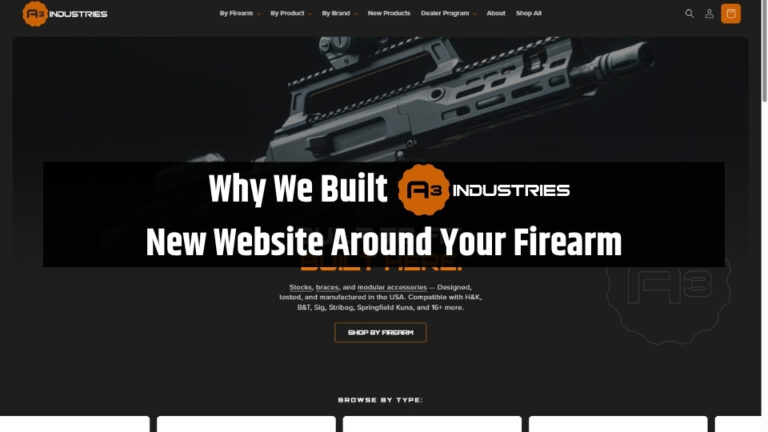
Accessory Buyers Start With What They Own
A lot of ecommerce advice assumes a customer who’s open to discovery. Show them categories, merchandise the collections, let them wander toward something they like.
Accessory buying in this industry tends to work differently. Most customers arrive already knowing what they own, and they have one question in mind: does this fit it? Finish, mount type, and price usually come after. When a site can’t answer the fitment question quickly, a lot of those visits end there, and homepage merchandising rarely wins them back.
We knew that going in. We work only in firearms, hunting, outdoor, and defense, so we came into A3 Industries already understanding the company, the products, the platforms they support, and how their customers buy. We didn’t spend the first month of the project learning what a brace is or why an SP5 and an SP5K take different parts. That understanding shaped every decision we made, starting with the structure of the site.
A3 Industries builds modular stocks, braces, adapters, foregrips, and chassis systems across a long list of host platforms. One product may fit a dozen firearms, another fits one specific model, and many are bought together as a configuration rather than one at a time. Their old BigCommerce site left much of that sorting to the customer. We moved them to Shopify and organized the new site around fitment from the navigation down. It went live this week.
Shopify Is Open to the Firearms Industry Again
For years, firearms brands were steered away from Shopify, and plenty of them still assume the door is closed. It’s open again. Shopify is friendly to firearms industry brands, and moving from BigCommerce to Shopify has become the most common development request we get.
Before we recommended the move to A3, we confirmed their eligibility directly with Shopify, then kept the payment gateway that already worked for their category rather than forcing a swap at launch. That’s the kind of question that’s much cheaper to answer before the proposal than after the build.
Built From the Ground Up
We didn’t buy a theme, change the colors, and stack plugins on top. We wrote A3’s theme in custom code from the ground up, around their catalog, their platforms, and the way their customers shop.
That distinction matters more than it sounds. A purchased theme is built for a generic store, and every feature it doesn’t have usually becomes an app – each with a monthly fee, its own update schedule, and its own way of breaking. A custom theme puts the features where they belong: in the site, under the client’s control, with as little rented as possible in the middle of the checkout. It also lives in version control, so every change is tracked and any future developer can pick up exactly where we left off.
We built the fitment logic into the store’s data model rather than into product descriptions. Firearm platforms and product types are structured records, and the platform pages, the compatible-firearm filter, and the “fits these firearms” line on every product all read from the same source. Change the data once and the whole site updates.
We built two parallel paths into the catalog:
- Shop by firearm covers 21 host platforms and continues down to specific models. We broke 15 platforms out to model-level pages – Scorpion, Bren 2 and Bren 805 under CZ; APC, GHM, SPC9, TP9 and USW under B&T; P50, CP33 and RDB under KelTec – rendered as filter pills with live product counts, so narrowing from brand to model never hides the other options.
- Shop by product covers 13 categories for the customer who knows they want a brace and wants to compare across platforms.
Where those two paths cross, the site generates its own landing pages. A customer searching for braces for a specific platform lands on a page built for exactly that combination, rather than a general category they have to filter down themselves. Those intersection pages are built automatically from the same fitment data, which means they keep up with the catalog without anyone maintaining them by hand – and they give search engines a dedicated page for the specific searches A3’s customers actually run.
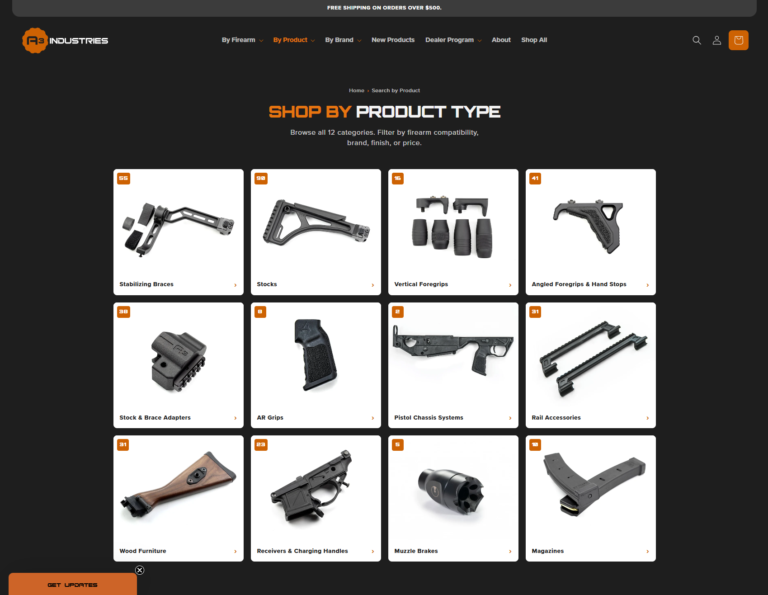
Handling Universal Parts and Rare Platforms
Not every part is built for one specific firearm. Picatinny-mounted accessories, M-LOK panels, QD sling sockets, and monopods attach through a standard interface, so they work on any firearm that has that interface. In a store organized by firearm, those parts have a way of disappearing: filter by your gun, and the products that fit everything vanish because they aren’t tagged to anything in particular.
We gave those parts their own Universal designation. They stay visible whatever firearm a customer filters by, and on product cards they show “Universal fit” instead of a list of every platform they’ll mount to.
The opposite problem shows up at the long tail. A3 makes parts that fit some firearms with only a handful of compatible products – not enough to justify a dedicated platform page, but enough that an owner should still be able to find them. We built a way to make any firearm a selectable filter option without creating a page for it, so a customer shopping for a stock that fits a less common platform can still narrow to it, and A3 can add new platforms to the filter without adding thin pages to the site.
The Configurator We Didn’t Rent
The most important function on A3’s old site was selling a stock together with the adapter that attaches it to a specific firearm – roughly twenty adapter options presented as part of configuring the product.
On paper, this looked like a problem. Shopify limits a product to three options, and some of A3’s old product pages showed as many as six dropdowns. Many agencies would reach for a paid product-options app at that point. Instead, we went through the old catalog and found that only two of those dropdowns were true variants. The rest were separate add-on products presented as options. That changed the problem entirely.
We built the configurator into the theme:
- Add-ons appear as steps in the product’s configuration flow, with a running total as configured
- Each add-on stays a real product with its own SKU, price, and inventory, so selecting one never alters the stock’s SKU
- One Add to Cart adds the stock and every selected add-on as separate line items, with inventory deducted for each
- A3’s team controls which add-ons appear on which product, and what each dropdown is called, through fields in the product admin, with no developer involved
No app and no monthly fee. And because A3 manages it themselves, a new adapter can be on every compatible product page the day it ships.
Built for the Phone in Their Hand
Discovery data showed that more than 90% of A3’s visitors were on mobile. That changed how we approached the product pages in particular: a configuration flow with a twenty-option adapter selector reads very differently on a phone than on a desktop. We designed the configurator and the filters to disclose options progressively, so mobile customers see the next decision rather than every decision at once.
The Migration Nobody Sees
The part of a replatform that gets the least applause is often the part that protects the business most. We handled all of it:
- We redirected every legacy URL. 590 redirects cover the old product pages and every old shop-by-firearm category URL, including model-level ones, so years of accumulated links and search rankings land where they should.
- We migrated the full catalog with variants, pricing, images, and fitment data, then audited it rather than assuming it was right.
- We recovered the photography. An export pulled months earlier pointed at image files the old platform had since deleted. We recovered what could be recovered and itemized the rest for A3’s team, finishing with every active product carrying photography and no broken images anywhere in the templates.
- We rebuilt dealer pricing as automatic discounts tied to customer segments, applied in the cart the moment a dealer signs in. No codes to hand out.
- We spared returning customers a password reset. The store uses Shopify’s passwordless accounts, so imported customers simply sign in with their email address.
- We carried over and tested the compliance content, including California shipping, product disclaimers, warranty, and installation instructions across the catalog.
- We set up dealer applications to accept FFL and resale certificate uploads, which native platform forms don’t support.
- We fixed the shipping data. Placeholder weights on heavier products were replaced with real ones, so customers see accurate shipping rates at checkout.
We ran a QA pass across every product category before launch, then A3’s own team placed live test orders as customers. When we handed the site over, A3 got the codebase, an admin guide, and setup documentation along with it.
Why It Worked
We understood the business before we touched the code. Knowing the products, the platforms, and how this customer buys is why the site is organized around fitment instead of around a template’s idea of a store.
We wrote it, we didn’t assemble it. A custom theme put fitment, filtering, and configuration inside the site rather than spread across rented apps.
We read the data before solving the problem. The variant limit that looked like it required an app turned out not to exist once we understood how the old catalog was actually built.
We settled the platform question first. Confirming Shopify eligibility before the recommendation meant there was no surprise waiting at launch.
We protected what the old site had earned. Redirects, metadata, and reviews moved with the catalog, because a replatform that loses its search footprint isn’t much of an upgrade.
We built it for A3 to run. Add-ons, filters, fitment, and content are all client-editable, and the documentation went with the site.
Services Involved
- Website Design & Development – Discovery and information architecture, site audit, design, custom Shopify theme development, catalog migration, integrations, and launch.
- SEO – URL strategy, 590 legacy redirects, intersection landing pages, and page metadata across the catalog.
- Email & SMS Marketing – Klaviyo flows and product data migrated onto the new platform.
Ready to Talk?
If you’ve been told your brand can’t sell on Shopify, or your current site leaves customers to figure out fitment on their own, we should talk. Fill out the form below and tell us what you’re working with.