A collection-page rebuild, a non-brand keyword strategy, and a navigation overhaul that moved Eclipse Holsters onto page one for the biggest terms in the holster category.
Search is the one channel where the work you do today keeps paying out months from now. A paid campaign stops the day the budget stops. A ranking you earn on a high-intent term keeps sending buyers every day it holds. That compounding is exactly why Eclipse Holsters made SEO a primary driver of their direct-to-consumer growth – and why the results are still building.
Eclipse Holsters makes premium custom kydex holsters for concealed carry. They compete in one of the most crowded product categories in the firearms space, where hundreds of makers chase the same buyers searching the same terms. When we took over SEO in January 2026, the goal was not a quick traffic spike. It was to build a durable organic engine on the terms that actually convert – the non-brand searches where a buyer is looking for a holster, not looking for Eclipse by name.
Here is what that looked like, and where it landed.
Why Non-Brand Is the Number That Matters
There are two kinds of organic search traffic, and they are not equal.
Branded traffic is people already searching for you – “eclipse holsters,” “eclipse holster review.” That traffic is valuable, but it mostly reflects demand you have already earned somewhere else. It is a mirror, not an engine.
Non-brand traffic is the engine. It is the buyer typing “glock holster” or “concealed carry holster” or just “holster” into Google with no maker in mind, ready to be won. Ranking on those terms is how you reach people who have never heard of you. It is also far harder to earn, because every established competitor in the category is fighting for the same positions.
So when we measure this program, we measure non-brand. Every number in this case study is non-brand organic search unless stated otherwise. That is the honest way to show whether the work reached new buyers or just re-counted the ones already coming.
The Foundation: Collection-Page Architecture
The first and biggest lever was structural.
An ecommerce catalog wants to rank the way buyers actually search. People do not search for a SKU. They search for a category – “kydex holsters,” “iwb holster,” “psa dagger holster” – and they expect to land on a page built around that category, not a single product. On most Shopify stores, those category pages are collection pages, and they are usually an afterthought: thin, templated, and invisible to search.
We rebuilt them. Working alongside the Eclipse team, we developed a scalable collection-page framework and applied it across 33 firearm-specific pages – holster and mag-pouch collections mapped to the exact firearms and carry styles buyers search for. Each page was built to earn a ranking on its own terms, with structure, copy, and internal linking aligned to search intent rather than catalog convenience.
Then we overhauled the main navigation so those pages were properly linked, crawlable, and organized the way a buyer thinks. Good architecture does two jobs at once: it helps Google understand the site, and it helps a shopper find the right holster in fewer clicks.
The Strategy: Winning the Head Terms
With the architecture in place, we went after the terms that define the category.
Head terms – short, high-volume searches like “holster” and “glock holsters” – are the hardest positions in any market to win, because everyone wants them and Google reserves the top spots for sites it fully trusts. Most brands never touch them and settle for the long tail. We treated them as the goal, mapping 334 net-new non-brand keywords to the rebuilt pages and optimizing relentlessly against them.
The movement on those head terms is the clearest proof the work landed. Comparing where Eclipse ranked before the engagement to where it ranks now:
- “holster” climbed from position 9.1 to 3.8 – off the bottom of page one and into the top four, against tens of thousands of monthly searches
- “glock holsters” climbed from 8.6 to 2.1 – nearly the top of page one
- “glock holster” climbed from 8.6 to 3.4
- “concealed carry holster” climbed from 14.0 to 8.7 – off page two entirely and onto page one
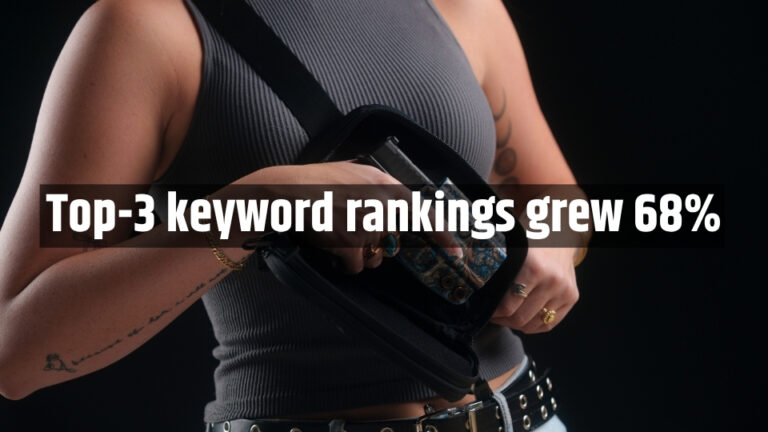
Across the program, top-10 non-brand keyword rankings grew 58%, and top-3 rankings grew 68%. Those are not vanity long-tail wins. They are the competitive, product-intent terms where a buyer decides who to buy from.
Where the Program Landed
Ranking gains only matter if they turn into people arriving on the site. They have.
Because search demand in this category is seasonal – it rises and falls the same way every year – we measure results year over year, comparing each month to the same month a year earlier. That is the only way to know whether growth is real work or just the calendar.
Measured that way, spring and early summer 2026 beat 2025 across the board:
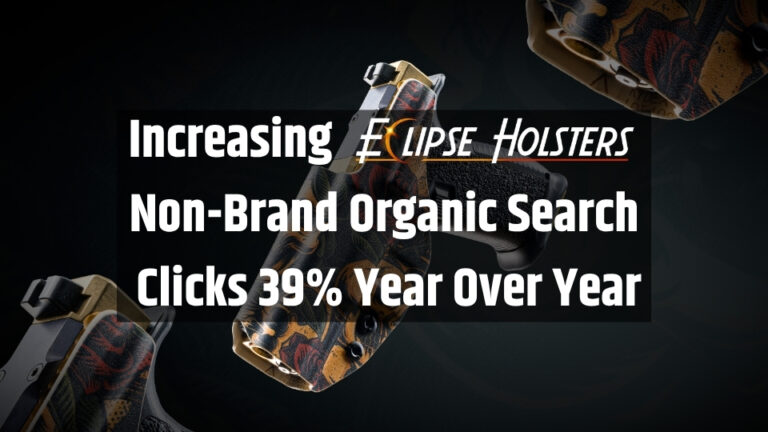
- Non-brand organic clicks grew 39% year over year across March through June – every single month up on its prior-year counterpart
- Non-brand impressions grew 45% year over year over the same window – the visibility that leads clicks
- The rebuilt collection pages grew 28% year over year in non-brand clicks, making the subfolder we rebuilt one of the strongest-performing sections of the entire site
That last number is the one we are proudest of. It means the growth is not luck or a stray viral moment – it traces directly back to the architecture we built. The engine we installed is the part of the site that is measurably pulling.
And it is still early. Google rewards proven pages gradually, so the full traffic payoff from a rankings gain arrives over the months after the ranking is earned, not the week of. The keyword positions Eclipse holds today are a leading indicator of clicks still to come. The program is compounding, exactly the way search is supposed to.
The Takeaway
Eclipse Holsters did not need a traffic trick. They needed an organic engine built on the terms that reach new buyers – and built to last.
That is what SEO is for, and it is what we do. We build the architecture, win the terms that matter, and measure honestly against the calendar so you know what is real. In a category as competitive as concealed carry, that discipline is the difference between renting attention and owning it.
If your brand competes in a crowded category and you want organic search working as a real growth channel – not an afterthought – let’s talk. We build SEO engines for firearms, defense, outdoor, and tactical brands, and we measure them honestly.